Tuesday, June 19, 2007

What a Difference a Fortnight Makes

Liam Byrne MP
Liam Byrne - Stripped of his Medal
It was just over two weeks ago that I, in a spirit of fairness awarded my first ever medal for common sense to a member of the current government. The recipient was Home Office Minister Liam Byrne for his relatively prompt action over the case of Tul Bahadur Pun VC. My little on line medals are not though a real medal like Tul Bahadur Pun's Victoria Cross, one that, by the decree of a King, can never be withdrawn even if a recipient was convicted of a high crime and found himself on the gallows. I had of course forgotten that Mr Byrne has responsibility for the introduction of ID cards; had I remembered I wouldn't have wasted the time adding the initial award.

Mr Byrne has, according to the BBC, gone on what he doubtlessly sees as being a 'charm offensive' over this offensive innovation in government interference in our lives, along with it's real raison d'ĂȘtre, the National Identity Register (NIR).

According to Byrne:
The identity card scheme will become a "great British institution" on a par with the railways in the 19th Century.

The National Identity Scheme "will soon become part of the fabric of British life"

Source: BBC News

What planet is this man from? I can only assume he's been on a tour of the evidence storage facility at some police station and decided to sample the contents of the narcotics locker. Please, please let Euripides be right:
"Whom the gods would destroy, they first make mad."

Euripides (484BC - 406BC)

If so Byrne can expect a lightning bolt to be on its way very soon. What does he have in mind? That compulsoryhappy family trip down to the registration centre where mum, dad and granny can all enjoy the thrill of being fingerprinted like common criminals, while the kids sob that they can only be on their school's database for now? The belly laughs at the bank when the you can't get any money out because something has gone wrong with their fingerprint scanner? The glee at opening that special envelope to find out you've been fined because you forgot to add 'better tell the ID card people' to the thousand and one things you need to do when you move house? Don't be ridiculous.

Look at every 'Have your say' type message board on the issue, Mr Byrne. The tide has turned. People are becoming aware of the disaster the scheme will become, even if you're bogus cost estimates had been closer to the mark. Other than the a tiny, dwindling band of 'nothing to hiders' most of the remaining supporters seem to be people with an immigration obsession. I suspect many of your limited number of fans are not people you would like to associate with. It's probably not fair in this case I suspect, but by your friends I'm afraid, you will be known. Unlike you, most of them are too daft to realise that in the absence of exit controls there will be damn little impact on illegal immigration.

I suppose at least he concedes that Parliamentary scrutiny will be required of some of the plans to "multiply the uses" of ID cards. It doesn't really sound like the simple hassle-free scheme that they tried to sell though, and he doesn't mention the vast number of uses already anticipated in the act that presumably he considers to have been adequately scrutinised.

NO2ID - Stop ID cards and the database state
No2ID Fighting On
I'm not going to rehearse all the arguments against ID cards as No2ID does it so well. If you are daft enough to believe any of the reasons the Government has churned out as its immediate predecessor was debunked, go and take a look. Let's be honest, some of the comparisons with the Third Reich's ID systems is a bit over the top, but there can be all sorts of hidden dangers in this type of system, even if it's primary purpose is, as I suspect, convenience for bureaucrats at the expense of the people.

Take for example the fact that the police will have the power to trawl the database in the case of serious crime, eventually containing the majority of adults in the UK, for a match against crime scene prints. Sounds reasonable? Think about DNA evidence. There was a time when this was only used in serious cases, and limited samples taken, those of the innocent being destroyed afterwards. Then the power to take DNA samples from anyone arrested became used to the full, and in time the goverment made almost every offence arrestable while the innocent lost their rights to have their samples and DNA profiles deleted. We now have a DNA database half as big again as the rest of the world combined and it is searched in cases involving ever more petty crimes.

DNA
DNA evidence use exploding
Some will be happy with our fingerprints being trawled too as they have 'nothing to hide'. I tried to find out how long a fingerprint you have leave, say down at the local shopping centre would remain usable. The concensus was that if it happened to be in a spot that wasn't cleaned too often, the answer was in effect 'indefinatly' with little chance of determining when the print had been left as is sometimes possible with DNA evidence. What happens when there happens to be an serious assault near this fingerprint, you were alone at home at the time of the assault, and maybe had some vague casual connection with the victim? Work? School? The pubs you drink in? That's right, you go well up the suspect list all because you touched something on a shopping trip a few months before. I've got a lot of time for the police, but that doesn't mean that there have not been a couple where we've mutually got up each other's noses.

The burden of proof will mean that you probably won't get wrongly convicted, but you'll won't have a great time while you try to prove your innocense. Perhaps all those people who have 'nothing to hide' are so public spirited that they will either wipe down every surface they touch to avoid the inconvenience or log the contact in a little notebook and ask a passer-by to witness the fact.

Even if you could accept the inconvenience, would it improve society? Do people drive better because of speed cameras? The evidence suggests not and it even seems that the switch to an apparantly miraculous technology may have contributed to a decline in driving standards as resources are withdrawn from traditional patrolling in favour of easier to process McCrimes. I've only been interviewed, as a witness, once by the police in my life. I have an awful feeling that for everyone on the NIR it will become a much more regular experience within a few years, as simplistic trawling for suspects takes the place of more difficult police work.

No2ID stick very much to hard headed facts on the issues, but I'm going to admit that part of it is, for me, the image of ID cards too. They will never become a great British institution, for me they are a symbol of everything wrong with one other British institution, HM Government.

Monday, June 18, 2007

Be Careful What You Wish For – Part I

Constitutional Treaty
ConstitutionalAmending Treaty
Name change, job done?
There's been predictable howl's of outrage in the Conservative blogosphere over Downing Street's announcement that there will indeed be no referendum over any EU treaty changes. There seemed until today to be no hard definition of what diminution of the scope of such changes is required to allow the Government to feel free to abandon their manifesto commitment to such a referendum. Now we know that the handful of 'red lines' that Blair (but possibly not Brown) will insist on, but we know from his Blair's track record on 'red lines' that these commitments are meaningless. We have to assume the simple deletion of the word 'Constitution' will, in the end, suffice for our discredited Prime Minister and that for all the more encouraging sounds from the Brown camp it hardly seems likely that he would want to activly jump back in to the same mire as his predecessor ended up to his neck in.

It wouldn't be very interesting simply to parrot the standard, and in my opinion very convincing arguments of other Eurorealists, so I thought I'd take a slightly different tack. I actually used to be relatively pro-EU, even beyond the immediate aftermath of the Maastricht treaty. It has only been the ensuing years that have changed my view as the Commission, Parliament and Court of Justice of this insidious organisation have bullied and blackmailed as they twist, misuse and over interpret their powers to allow ever more functions to be exercised with ever less competence and common sense. I can still remember my pro-EU instincts but something tells me that, even if I had slept through the last 15 or so years, I would be one of those increasingly common Europhiles who would have the very gravest of misgivings right now, both over the nature of the constitutional arrangements proposed and the way in which the whole process of trying to implement them has been conducted. I thought I'd cast my mind back in time, forget about the intervening years, even as a mind experiment to pretend to have positively federalist instincts, and examine why this is.

There are very many reasons behind the hostility of this 'hypothetical me' to what we may soon be asked to hostility so I'm going to tackle it in two posts. Here I'll look at the Constitution itself and later the discreditable process that continues today to implement its provisions. It is all, I will admit predicated on the assumption, which history tends to show to be a fairly valid one, that the analysis of what the meaning of the changes by Germany's Chancellor of the day tends to be more accurate and honest than that of the serving British Prime Minister. I don't mean to take a cheap shot in saying that; I understand the reasons why British governments feel the need to present things the way they do, even if I do deplore them. In other words I do tend to believe Ms Merkel when in her assertions that it will be the Constitution in all but name, and as such I will frequently refer to 'the Constitution' as shorthand for whatever convoluted mechanisms are employed to enact its original aims.

So firstly, to rehearse some of the objections a proponent the EU may legitimately have to the Constitution itself, or the relabelled version there of. There seem to be facing has a number of elements that I could never accept regardless of the institution, or institutions, to which it applied. These have all been argued aplenty in recent years but the following would have been my Pro-EU self's main objections.
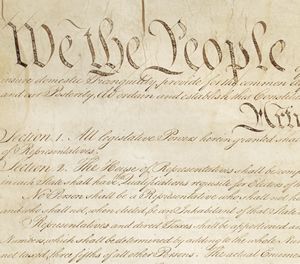
US Constitution
US Constitution - Just 17 amendments in 215 years
How many each year for a EU equivalent?
Process of Amendment: Most constitutions set a very high bar for amendment of their provisions, usually little short of the process by which the original constitution is adopted, if at all. This gives people confidence in the rule book that their legislatures must work within. The proposed EU arrangements allow for the bar to be very substantially lowered, removing the need, for those nations with a requirement or a tradition of allowing their people a say in changes to the structures within which they are government, to consult their citizens.

It's easy to understand why such provisions would be so highly prized in Brussels but they are still profoundly wrong, the equivalent of Westminster's Regulatory Reform Bill, which it is interesting to note that the most Europhile segment of MPs were bitterly opposed to, despite one of its roles being to aid the transposition of EU law in to our statute books without the tedious process of parliamentary scrutiny. It's no good to say that there was already the 'passarelle' provision. That was more limited in scope and equally objectionable.

Permissive Drafting: I think one of the reasons Americans still respect their constitutions, above and beyond its simple and rather inspiring language is the frequent use of phrases akin to 'Congress shall not…' It inspires hope and belief that there are limits to their government's ability to interfere in their everyday lives, no matter what government they may one day elect and what that government may wish to do. It is a contract between the state and its citizens, the terms of which are to this day is frequently enforced by an arbiter which, though perhaps not being fully impartial, is far less politicised than the ECJ; all US administrations know that any attempt to vary the terms of the contract in it's favour are almost certainly doomed to failure.

EU treaties take an opposite approach, in explicitly suggesting lists of areas in which governments, both national and EU may wish to act and providing few if in any no-go areas for interference by the state. Even those that are implicit in the charter of human rights can be overridden 'In the general interests of the union', not just the times of national emergency that most other constitutions accept as a minimum for the suppression of basic rights. If the ethos of the Constitutional Treaty and all previous treaties is maintained in any new arrangements the suggested areas for EU action will clearly carry with them a sense of being 'just for starters'. EU citizens will continue, unlike their American counterparts, to feel no confidence that they are governed ultimately by their own consent.

Vagueness: This is really just a variation on the theme above in many ways. One of the things that actually had me leave the moderately pro-EU camp was the successive interpretations by Commission and ECJ alike to interpret each and every provision in the most self aggrandising way possible. There was a clear need to much more prescriptive instruction to these organisations, but the original Constitutional constitution opened existing loopholes even wider.

As an example, there was nothing too offensive to me, at the time, about the idea of an adjunct 'European Citizenship' as it was presented at the time of Maastricht. This changed as evidence rolled in that both these bodies saw that this should eventually become our primary identity. This was a concept not foreshadowed in the treaty which was mute on the matter and I don't think that our leaders, on this matter at least, deliberately misled us. Any new arrangements should have either provided more specific directions to EU institutions, or in the alternative contained a directive that all provisions should carry an interpretation that is the most limited in terms of transfer of authority to Brussels. If EU bodies feel they need more powers they should always have to ask specifically for them rather than seeking mechanisms by which the scrutiny that provokes can be sidestepped. In many cases it was not the goals sought by the EU that caused offence but the underhand means by which it sought to achieve them. Even as a Europhile I was able to understand that, but it’s a concept that seems incomprehensible to more avid supporters of the project.

Competencies: To be honest I wasn't entirely happy with any of the proposed extensions of EU competencies, be they new areas of EU action entirely, or the migration of existing ones controlled under unanimity to QMV. Even with a generally positive outlook on the EU I felt most were a step too far that even if I felt I could live with, were doomed to cause nothing but discontent with, and disdain for, the EU.

The two headline areas that always crop up are foreign policy, and criminal justice. At a pinch I felt that subject to getting rid of the hopeless Javier Solana, a man who has made the wrong call on nearly every major decision throughout his life, and no change of UN Security Council representation, I could just about live with the former. Criminal Justice was, and is, a big no-no. It's unnecessary, as the disparate legal systems between England and Scotland for centuries of much closer union proves beyond doubt. The reasons quoted for it have also always been thoroughly dishonest. Who is vetoing vital anti-Terrorism measures other than for good reasons perhaps of civil liberties anyway? Too often the veil slipped and it was clear from day one it was more about smoothing the passage of more controversial measures such as a nebulous concept of xenophobia (the EU version, which excludes the US from nations you are not allowed to hate), a peculiar Italian view of counterfeiting (which targets the perhaps unwitting buyer of fake goods rather than the manufacturer) and foolishness like the swastika ban where individual nation states clearly have different issues to confront and different ways of tacking them.

Did anyone even pause to wonder what would happen when a case came before an English jury with, if statistics are to be believed, at least three people hostile to the EU project, and they heard that the law the defendant was being prosecuted under was not desired by Westminster but was an outcome of EU fiat? It's not impermissible to argue a jury nullification line in the English courts as I understand it. It is not usually a good strategy as most people are driven by a respect of the law, but when you force people to live under a system of law they may not accept the moral legitimacy of this would change.

I don't care now if the EU wants to make an arse of itself. I did then. Even NuLab have pushed this too far themselves, and look what happens – you end up with Nick Griffin celebrating his acquittal outside the courtroom. I always felt this would be the fate of most EU inspired prosecutions.
Ballot Box
A sight to strike fear into any commissioner
Malapportionment in the Parliament: The Constitution did try to tidy the old formula for the size of each countries delegation, which was largely decided through horse trading, but the overrepresentation of smaller countries is still excessive. Ok, I can understand why Luxembourg deserves one whole MEP to itself which its size does not warrant, maybe two for reasons of practicality, as is the case for US congressional representation, but six?

I don't hear Wyoming demanding the type of overrepresentation that Luxembourg would continue to have in the reformed parliament, with each of their voters carrying the weight of roughly twelve German ones. One man one vote and, with all the great respect I have for Poland, square roots of people have no place in democracy either for all their mathematical uses.

Immunities: The Constitutional Treaty retained and extended the scope of immunity from prosecution for all manner of people working for EU institutions. If there's one thing I thing the EU could learn from Westminster's model of governance is the very limited scope of such immunities as Parliamentary Privilege. Equal treatment is an essential component of any good system of law; the fact that our representatives can and do fall foul of the laws they create and end up in court is, in the longer term a strength and not a weakness of the system.

Language: Let's be honest, and I think nearly all sides of the debate agree, the whole thing is a turgid dog's breakfast of a document. Even the attempts at sounding inspirational, confined mainly to the preamble, sounded hackneyed and unconvincing. This was even before the opening references to 'We the people of Europe…' became ludicrous as the evidence rolled in that this was anything but a project of the people of Europe.

I've actually read the whole damn original Constitutional treaty, and there were many other things I disliked, but on the other hand I could either live with, or in the alternative see not surviving the passage of time as national interests, common sense and practicality all intervened. These other issues, I counted roughly forty of the splodges of pink highlighter pen I used mark them with on my hard copy, would not have stopped me voting for such a Constitution in my Eurofanatic youth. I cannot though, imagine, no matter how I try, how much more pro-EU I would have to be to accept any settlement with the issues above, other than perhaps the last, still standing.

So that's why I don't like what was on the table, and what may be being reheated right now, but since I'm doing thought experiments, in the next instalment I will pretend these objections don't exist and that the whole document was entirely to my liking. Part II will look the folly of anyone who claims to have interests of Europe, or even the EU, at heart in accepting the way things have progressed since the French and Dutch rejections of the original Constitutional Treaty even leaving aside any question of it's democratic legitimacy.

Saturday, June 16, 2007

Lessons from History

The Globe Reconstruction
I spent the whole of Tuesday night in back in the 16th century, surrounded by wattle and daub plaster, and sitting on a hard wooden bench, for which I was grateful, for otherwise I would have spent four hours standing, which I'd be reluctant to do even for a decent rugby match. Note to Saracens, or rather Watford Football Club, our landlords: the Elizabethans had a much simpler, cheaper and more importantly more comfortable approach to seating crowds than you do. Down below sundry people, dressed inappropriately for the warm weather but more appropriately for the era in which we found ourselves were acting out 'The Merchant of Venice'. I was, of course, on the South Bank, at the modern recreation of Shakespeare's Globe.

It's a play I've seen a few times before on stage, and on screen, but even if I had the critic's vocabulary to pass judgement on the performance I don't really feel qualified to say whether it was a great performance of what modern attitudes have made one of Shakespeare's more controversial offerings. It was the first time I've been to the Globe and all I can really say is that I enjoyed both the play and the experience. I realised it's the very first time I've seen Shakespeare performed on stage, in the original language and, insofar as the history can tell us, pretty much the way it was originally staged. There were a few minor tweaks, all outside the actual text, probably to play up to those in the audience who thought 'Shakespeare in Love' was some kind of documentary. The only major innovation was the introduction of women to play the roles of erm…women, apart of course in the penultimate act when the women who were for once playing women had play the role of men.

To add to the confusion the actress playing Portia had gone AWOL, presumably through illness, and this being a very short run there was no understudy. The show must go on, and so it did with Nerissa promoted to her mistresses' role and a new stand-in Nerissa both reading from day-glo highlight adorned scripts. Come the courtroom scene they bizarrely they interchanged roles again with the stand-in Portia reverting to being the real Nerissa, albeit in the guise of the clerk, and the stand-in Nerissa becoming the stand-in Portia playing the role of the man of law. It's ok, the director had apologised to the baying crowd in advance, and even the times there was an occasional stumble and the carried scripts were needed, it took nothing away from the experience; I suspect even Shakespeare himself would have raised a smile at the added layer of confusion. In any case the inclusion of real women didn't seem to contribute to any great increase in public immorality though I'm sure some NuLab department was monitoring the situation closely.

The night had many typical elements of a trip to see Shakespeare performed. There was the group of American students travelling the world with their script and notes on the text who, of course, dutifully laughed on every cue, but at least took an interest. There were the po-faced British theatre goers making disdainful faces at such behaviour, while their own children were either by their side looking sullen and disinterested or, I suspect, indulging in Cool Britannia's modern alternative of hanging round a bus shelter looking sullen if they were too young for binge drinking. Thankfully a traditional setting deterred most of the ArtPOLs who would, if they had two grey cells to rub together, have been there commenting on some of the more anti-capitalist sentiment in the play and the strong role played by the lead women. I guess the lack of a physically handicapped, transgendered or openly homosexual character must have been what put them off, because I think they would probably have enjoyed the Jew-bashing.

Other than the lack of leftism sufferers empathising with something or another, the other thing that was less typical was the rest of the audience. Looking down from our perch there the overdressed, ageing crowd that is a common sight at many theatrical events was conspicuous by their absence. In their place was a collection of t-shirts, football shirts and rugby shirts mixed in with outfits clearly designed for after theatre clubbing. Many, at the start, also wore slightly less than enthusiastic “oh well, I suppose even though we couldn't get into Les Mis we'd still better do the theatre on our London visit” expressions. By the end, almost all were captivated by it and there was a raucousness to the applause at the final curtain call that you'd rarely see in the West End. The loudest of it was rightly for the two stand-ins, including that from a couple of fairly heavyweight Hollywood stars I happened to spot in the audience. Removed from its often, in more ways than one, rather stuffy environment theatre had rediscovered fun.

Shylock and Jessica
Shylock and Jessica
Another part of the experience of the Globe is the activity that goes on outside the auditorium, where there is an attempt to recreate the atmosphere of an Elizabethan night out on the tiles. Yes, it is very much a pastiche, but I'm not sure Southwark Council is allowed to grant a prostitution licence even for artistic reasons and I'm the health and safety killjoys would have prohibited more authentic and probably more appetizing fare. There was something more modern though, that was notable by its absence; the religious protest. Any attempt at a rewrite recasting the role of Shylock as a Moslem, Sikh or yes as a Christian living in a world of different religious persuasions, would, I suspect, be less fortunate.

I might have a 'plague on both your houses' attitude to the whole Israeli/Palestine issue, but it's hard not to respect the good humour with which the Jewish Diaspora tend to accept both jokes at their expense and more poisonous comments with their own self-deprecating humour in the first case and a calm stoicism in the latter. It's an attitude in very short supply in many of this country's minority religions and is sadly being lost at an alarming rate amongst sections of the Christian community, who are themselves starting to man the barricades and picket lines in a search for special, unequal treatment.

There have been many attempts to perform a modern post hoc reengineering on Shakespeare's attitudes to Shylock in more modern times, either pointing to the more sympathetic 'If you prick us, do we not bleed?' passage of his courtroom appearance, or more general themes of redemption.
I am a Jew. Hath not a Jew eyes? hath not a Jew hands, organs, dimensions, senses, affections, passions? fed with the same food, hurt with the same weapons, subject to the same diseases, healed by the same means, warmed and cooled by the same winter and summer, as a Christian is? If you prick us, do we not bleed? if you tickle us, do we not laugh? if you poison us, do we not die? and if you wrong us, shall we not revenge? If we are like you in the rest, we will resemble you in that. If a Jew wrong a Christian, what is his humility? Revenge. If a Christian wrong a Jew, what should his sufferance be by Christian example? Why, revenge. The villany you teach me, I will execute, and it shall go hard but I will better the instruction.

Shylock, The Merchant of Venice
Act 3, Scene I

For all the power of that one, and as far as I understand the play it is only that one, famous passage, overall it really isn't that convincing. Shakespeare tended not to create two dimensional Bond style villains, but even with the darkest of characters tended to introduce a small degree of humanity to make them more human, and thereby their depravities all the more terrible. I've always been more inclined to the line that the programme notes also followed, that yes, Shakespeare was an anti-Semite, but then, in this particular case he was not a man for all time, but very much a creature of his own time, and those times were very hostile ones in which to be a Jew.

Where is the value in suggesting that plays that contain attitudes would today be unacceptable should perhaps not be performed, as is sometimes the case? Why should we perform logical and literary gymnastics to pretend that a work carries a message that it patently does not, or worse still rewrite it to make it more acceptable to modern ears? I would suggest there is no merit in any of these approaches. If someone wants to do some rewriting, relocation or rearranging of a play, fine, do it. Do it for reasons of genuine innovation or creativity though, not because of some absurd sensitivity about the attitudes of the past. Let these stand, let them be understood even if they be reviled today. Let it be seen that even the most brilliant minds of an age can succumb to the prejudices of their time; we might even learn something about the dangers of accepting, without question, some of the prevailing wisdoms of our own.

Friday, June 15, 2007

Flying by the Seat of Your Pants

Tom McRae
Tom McRae
OK, time to take a risk. I email into the Microblog all the time, but this will be a first. A real time, main blog entry without the benefit of a spel chicker*. So with apologies to those who spent several years trying to teach me the intricacies of my native tongue, here goes...

At the start of writing this it's coming up to 9:30PM on a Friday night, and for once I'm neither rat-arsed, nor in the Village. It's another night of culture at its best, and for once there is not a trace of sarcasm in that statement. Instead of being up in the good seats like Tuesday's trip to the Globe, I'm down in the good standing area on the ground floor of the Shepherds Bush Empire. Everyone is waiting for the arrival of one Tom McRae on stage. Not exactly a household name? No, but when you look at the success other British male singer songwriters have had it should be. He's got the talent, the voice, and even on-stage personality in spades without a trace of the tertiary twatism that so often goes hand-in-hand with it.

One tribute was the warm-up act, Steve Reynolds, who I think may have had a little more airplay of late since McRae's early impact and acclaim for his debut album, but played a great supporting role tonight, as did 'when will they stop using Brighter than Sunshine for musical highlights on the BBC' Aqualung the last time I saw McRae play live.

If you've never heard of him before I'd go have a listen, especially if he's playing live in a town near you - the studio stuff on iTunes doesn't quite do him justice, it's not overproduced or anything, just a bit sterile compared to the same songs played live, and there were a couple of great covers that didn't make the cut on the CDs I bought. His version of Oh Yeah! (On the radio) is fantastic, and La Nuit Je Mens (a cover of the Alain Bashung - I had to look him up too - song) is a classic even if I can't come up with a nice idiomatic translation of the line about trying to pull a Moray eel from the French.

Talent and superstardom are increasingly differing qualities as programmes like 'popsearchforamastericeskateronhorsebackstar', from ITV, C4 and the 'we tax you for quality's sake' BBC alike, show. I just hope he enjoys performing as much as he seems to, because its fantastic being in the audience when he plays.

*Update Saturday, 8:30PM: Following a challenge by an antipodean friend at the Base Camp I should state that this was not meant to be a dig at New Zealand English. Every idiot knows the that correct Kiwi for this software facility is 'Spill Chucker'. I can't wait to see Crus Jeck playing for Saracens next season so I've been brushing up on these matters.

Thursday, June 14, 2007

Compare and Contrast

House of Lords
The Lords: The People's House?
There are two principle bodies that are generally acknowledged as having a significant amount of control over the legislation by which we are governed but lack any real democratic legitimacy. One is wholly appointed, rather than elected, the other, for the time being, largely so. I refer, of course, to that venerable constitutional anomaly, the House of Lords, and around two hundred miles away, our lords and masters in the European Commission. I would argue that the Skoda minds of the British Civil Service, especially in cases of secondary legislation can have an unhealthy influence beyond their remit, but for now I will stick to the two more conventional pantomime villains. Both have made the news today, in the case of the former for very sensibly doing nothing, and in the latter for getting slapped down when it tried to do something it shouldn't.

First the good news. As trailed by Ian Dale on Tuesday,
David Maclean's Freedom of Information (Amendment) Bill seems to have run into the buffers yesterday. It has fallen foul of a twelve day time limit for finding a peer to sponsor it through the Lords, and now seems unlikely, for timetable reasons to make further progress. Confirmation finally came via the BBC, who I suppose can't be blamed for taking so long to report what is, in effect, a story of nothing happening. Tom McNally, leader of the Lib Dem Lords is quoted as saying:
"It seems very likely that this squalid little bill will no longer become law. We are happy that this bill will not become law.

"It speaks volumes that no member of the House of Lords was prepared to support this legislation.

"It could be revived any time during this session but there is simply no parliamentary time.

"The government would have to extend its already extraordinary generosity to this bill to the point where it would become a government bill."

Source: BBC News

Government sources suggest that even they are now sensitive to this fact and, as much as they may still at heart want the bill, have signalled that no such generosity will be forthcoming.

I've got nasty images of some trumped up FOI disclosure hitting the headlines to apply CPR to this one, but, for now, I'll settle for keeping the hundred plus MPs who were prepared to vote in favour of this bill, bringing the institution they represent into disrepute, on my watch list. It's rare any Parliamentary chamber can claim to have entirely clean hands over the fate of a piece of legislation, but to a Lord and Lady the upper chamber can on this occasion. For all their anachronistic nature, they've once again put the people first. I'm going to put this one on the back burner now, but the campaign banner stays for now. After all, the EU Constitution has been stabbed with more steely knives than this bill as we know the beast is far from killed.

Which neatly takes over the water to Brussels and, erm, more good news, but only because the European Court of Justice has stepped in to stop the European Commission making 24 carat gold plated prats of themselves. The European Commission were very upset that under British Health and Safety law:
...every employer must ensure, "so far as is reasonably practicable", the health, safety and welfare at work of all his employees.

Source: EU Observer

This was obviously an anathema to a body for whom reason and practicality are unwelcome, alien concepts like referenda and democracy, so naturally they hauled the British Government in front of the ECJ.

The ECJ, probably being intelligent enough to realise how ridiculous this would, once again, make the EU look, threw out the case, regardless of how much they may sympathised with the desire for more opportunities for nit picking micromanagement, thereby saving the Commission from heaping more contempt upon themselves.

The commission apparently:
...saw the British phrase as "opening doors for employers to escape their responsibilities" if they could prove that extra safety measures would have been disproportionate in terms of costs, time or trouble when balanced against relevant risk.

Source: EU Observer

You could almost cry. There must be somewhere, buried in a dark recess of the Berlaymont, someone in the Commission with enough residual brain function to understand the connection between statements like this and the prevalence of what they like to write off as 'Euromyths' (Usually proposals that were so stupid, that though considered, couldn't quite garner enough support to try and push through the legislation, so where quietly shelved for another day).

Berlaymont
The Berlaymont: Heart of the Beast
The Commission, as well as much of the rest of the European infrastructure, seems to feel that they operate under a different system of reality from the rest of us mere mortals. As with so many slightly reasonable sounding statements from the Commission, all you have to do is consider the underlying logic to realise what kind of cloud cuckoo land these people live in.

To rephrase, without changing the meaning of the Commission statement above, what it is saying is that there is "no safety measure which can be considered disproportionate in terms of time, cost or trouble, if there is any risk whatsoever". It says exactly the same thing, but doesn't sound so reasonable anymore does it? But that's exactly how the Commission appear to see things.

It doesn't even begin to sound reasonable. Every day, for example we weigh up risk versus time and trouble every time we cross a road; when we opt for many kinds of investment we weigh risks against the financial rewards. To expect companies not to do some of the same calculations is preposterous. To do so is to ask them either to reduce risk to zero, which is not remotely possible, or in the alternative to spend an infinite amount of time, trouble or money to mitigate the ever diminishing but never disappearing risk. The weak position of the Commission is that they accept some risk is "unforeseeable". This does not help at all; not all potential risk that it is unreasonable to guard against is unforeseeable, it is just infinitely improbable.

This latest battle in the Commission's endless war on common sense is far from over, as they are going back to discuss the matter with the "social partners". Even the "social partner-in-chief" in the UK, the TUC, don't seem to want to associate themselves with this nonsense, and according to EU Observer, "British trade unions have poured scorn on the EU executive's general approach".

REACH Chemicals Directive
REACH: More Moronism
Another example of this lack of rational thought came back to haunt the land of common sense a few days ago, with the coming into force of the REACH chemicals directorate. Many will remember the Communications VP, Margot Wallström's blog contribution a few months ago, praising the then proposed directive, where she proudly announced:
"What does it change? REACH will reverse the burden of proof. Instead of the public authorities trying to prove that a chemical is dangerous, the producer will have to prove that it is not dangerous or that we can manage the risks"

Margot Wallström, EU Vice President
Source: Margot's Blog

Ok, not all negatives are impossible to prove beyond reasonable doubt, but this one effectively is. There is simply no way to 'prove that it is not dangerous', absence of evidence of danger is not evidence of absence, no matter how many tests fail to show such danger. What was the issue anyway? There was a day when the companies producing did behave recklessly but that was yesterday. The risks of litigation under existing law, along with the potential damage to the companies' image is more than enough to ensure a responsible attitude to safety. When exactly was the last case of the reckless use of a chemical known to be harmful anyway, that directives like REACH would have prevented? My guess that you'd be looking back to the Seventies, which I suppose is pretty much where the EU is still rooted.

I guess that the truth behind REACH lies in the combination of a lack of centralised, well paid job opportunities for the scions of the European elite to mismanage the process, the EU's aversion to efficient operational systems that demonstrate the failures of the ones it sponsors, and its unbreakable, but very damaging addiction to the precautionary principle.

The interesting consequence is for those, and I suspect there are many, who are members of both general environmental organisations like Greenpeace, who support REACH, and any of one of the varied hues of animal rights bodies, who are presumably against the increase in animal testing REACH will inevitably entail. It's really no longer intellectually consistent to be a member of both, but judging by the general coherence of the arguments by both types of body I suspect I won't hear too many membership cards being torn up. At heart, it's bashing business that's the real goal of these refugees many from the discredited hard left.

Wednesday, June 13, 2007

Yo Ho Ho and a Bottle of...Lemonade

Puritan Hat
New Labour, New Puritanism
It looks like nanny has taken to the waves. This time it's Transport Minister Stephen Ladyman about to send drunken sailors to bed with no supper. According to the BBC, the government is about to impose the same alcohol levels on amateur yachtsmen as upon drivers of motor vehicles, for everyone navigating a vessel with a length in excess of seven meters and capable of a top speed of over seven knots. I should be grateful I suppose that it wasn't a speed limit of 3.5 meters per second, but I suppose the seven/seven rule sounded better to his spin-meister.

Mr Ladyman is
"...satisfied that in bringing in an alcohol limit for non-professional mariners and in setting the exclusion limit at 7 metres and 7 knots we are providing the best balance between improving safety and avoiding unnecessary regulation."
BBC News

Hmm, a NuLab Minister "avoiding unnecessary regulation", that's like a tramp avoiding a Wetherspoons pub, so even for those who might be inclined to see this as something approaching common sense (myself not included) this announcement deserves a second look.

I do have a personal interest in this. I used to go sailing on a fairly regular basis, and enjoyed every minute of it. I was introduced to it by a colleague at work who, in addition to doing good work with the London Sailing project for the young and disabled, organised a fair number of fairly boozy cruises usually over a long weekend. Sadly I haven't been for a while, but he's a top bloke so I can't really be anything but slightly jealous about the fact that he had the chance to move away to work full time in the nautical world, escaping the life of IT sales.

The general itinerary was to for a dozen of us to get down to Lymington straight after work on a Thursday, provision up some 34-42 foot yacht with food and beer, then head down to a local pub to wait for the tide to turn. With luck there would be time for a trip to the sub-continental food emporium to fill bellies with something better than what we could rustle up in the galley. The trip to the Indian usually raised the most eyebrows as the traditional "same again, to take away" was asked for at the same time as the bill; another meal sorted out. After that it would be into the oily blackness of the Solent, far from pissed, but we had certainly taken cabs to and from the town, being over the limit that Mr Ladyman proposes. Wind and tide permitting the sails would soon be up, the engine off, and seven knots comfortably exceeded perhaps reaching such breakneck speeds as 18mph.

Yacht
Wait till you see it with
police stripes down the side
We would spend a few days visiting the fleshpots of Guernsey and the fleshpot of Alderney, depleting their alcohol stocks and adding needed variety to the local gene pools. The later was much assisted by the size of our vessel, being among the largest of those tendering invitations aboard to girls in various ports. After the traditional wind-down drinks in Yarmouth, we'd be home in time for a few more pints reviewing old sea dog tales in the local by the Tuesday evening. The total cost, including yacht hire and so forth, about £100, excluding food and drink ashore. If Mr Ladyman is quietly congratulating himself on a bit of toff-bashing he might want to compare that figure with 5 nights in Ibiza.

When we were afloat, those in charge knew what they were doing. and took it seriously, even if they had had a couple more pints than they would drive on. Many had prestigious levels of Yachtmaster qualifications, two were even Royal Navy professionals, but there is something unnerving about sharing a watch with people who's main job is keeping their particular class of vessel under water. Safety was paramount, was emphasised before every trip even before you got instructed on how to operate the toilethead. They wouldn't stand for dangerous levels of alcohol fueled behaviour, and one person had to dump his stash of exotic tobacco before each trip, though this was more for fear of having the boat confiscated than sunk.

One person's experience should not though define what the law should be, even if it does seem to drive a lot of the current government's thinking. I'm sure Broon, as the local minister's son probably spent many of his school days with his head shoved down the toilet bowl, but that's still no excuse for the misery he is about to inflict on us soon. So let's look more objectively at Mr Ladyman's proposals, let's even assume their may be some types of alcohol related behaviour that should be restricted whilst in charge of a boat.

So, seven knots then, speed kills after all...doesn't it? Seven knots is roughly 8 miles per hour or in other words twice as fast as a brisk walking pace and little over half the pace of someone trying to set a four minute mile. Woah! better start thinking about the havoc someone running for the bus after a few pints could cause. If anyone from the Department of Health has Googled on to this site, due the number of references to their useless Ministers it now contains, this is is not a suggestion. An act restricting people to walking pace after a skinful is not in the public interest.

Dart 18
Small Catamarans - Not Covered
How about seven meters then? Little boats are cute and they must be safe then, surely? Well let's leave aside the fact that, lets say a catamaran like the Dart 18 is well under the length limit but can comfortably exceed the speed limit suggested, it also has lots of sharp pointy endie bits, at least until Mr Ladyman has corks stuck on the end of them. Seriously though, is Mr Ladyman really suggesting larger boats are more dangerous? Remember we are not talking about supertankers here. Go out on something like a Dart under the influence and end up drifting too far off shore and you could be in deep shit, do the same in a decent size yacht and you'll probably be fine. Go out of your way, even sober, and try and capsize a 34 footer; without the help of very adverse weather conditions and you will fail. One little surprise squall and your little dinghy will be over. Things also tend to happen at a much lower pace and in an easier working environment as boats become larger.

Now all of this could be construed as an argument for applying the same regulations to all sailing craft, and so it could be if it wasn't for the ridiculously prescriptive nature of the regulation, tying the limit as it does to the same one applied for driving a car at 60 miles an hour along a winding country road. The drink driving limit is predicated on a number of factors, including: the relationship between alcohol levels, reaction times and speed, the nature of the physical skills that may be impaired under the influence of alcohol, and the potential risks to someone who drives under the influence, passengers or others they may encounter. On all of these criteria, being in control of a boat does not merit the same restrictive approach as applied to driving a car. Decisions do not need to be taken in fractions of a second, but over several seconds where a vastly higher level of inebriation would be required to produce dangerous impairment. The chance of a drink impaired decision leading to a negative outcome is also vastly lower, as is how serious such an outcome is likely to be.

Was a law to be proposed that suggested an offshore offence akin to reckless endangerment (which may already apply or have a maritime equivalent for all I know), and were that law to allow for the level of inebriation, as evidenced by clear impairment of abilities, to be considered relevant evidence in determining guilt or sentencing the guilty, it would seem reasonable enough to me. A jury could rightly send a message to the CPS should they seek to prosecute a few young men who had been caught sailing a yacht of significant size, safely albeit with one pint over the drink driving level. They could send a very different message to a defendant who was clearly off his head as he took a 6.9 meter speedboat for a 30 knot spin round a busy harbour. To be honest I suspect legislation to this effect exists, but is simply not nit-picking and rigid enough for the minds of the current government and the Skoda minds of the British Civil Service.

It might even be permissive enough to allow people to have a little fun, which would never do, would it?

If you do want something to keep your tiny little minds occupied, maybe ponder on the way we allow people to hire small but fast sailing dingies on along every beach front, regardless of experience or qualifications. I bet quite a few incidents involve such rentals. I don't suggest a harsh licencing regime, but perhaps encouraging a greater duty of care on those who offer such rentals. Most dive shops won't hand over scuba gear unless you show you have at least basic qualifications and nor should they. I wonder how many incidents that exercise Mr Ladyman's mind did involve alcohol, but where the alcohol was a minor issue when set aside a lack of experience. I'd be happy to be on a boat with some of my experienced friends if they were off their faces, but know I wouldn't risk taking out other people myself stone cold sober. It's not the same as saying "he's a good driver, it's OK for him to drive drunk", it's a different and rarer skill set, one taken very seriously and in which there has never been an acceptance of excess among those who practice it.

As a final comment, I notice that the evidence presented by Ladyman for the need to introduce new rules does not consist of clear unambiguous statistics about current problems of people at sea after a few pints, nor even a couple of illustrative examples. The Marine Accident Investigation Branch is mentioned, but as a branch of officialdom I'd like to see the data, and to assume that they are likely to have put forward a fully balanced position is to take far too rosy a view of such people. How long do the police want to lock people up without charge again? What drink drive alcohol level would they prefer?

He also rolls out that old hoary chestnut, that he:
...considered submissions from MPs on behalf of their constituents "who have had personal experience of the tragic consequences of accidents involving vessels, where alcohol was thought to be a causal factor"
BBC News

Ah, that will be the usual 'bulging postbag' that they are so keen to keep even statistical data on secret, and is always rolled out when objective data may be thin on the ground.

Update 14th June, Early Hours: To answer the same question from 8 different e-mails at once, yes, it was hard not to use the word 'ladyboy' once in the whole of that posting.

Into the Bunker...

Filton Golf Course
Golf Courses - Common Sense Under Threat
News from the BBC suggests a long awaited new front is about to be opened by the forces of political correctness. Their brand new shiny Panzer is a green paper proposing a "Single Equality Bill" targeting private clubs, with the usual suspects playing the media role as villains. Yes in the red corner, we have...The Working Man's Club (music hall style booing and hissing etc. from the right) and in the blue corner, the most evil, insidious type of body in the known universe, The Golf Club (squeals of genuine outrage from the left). As usual it isn't so much an "Equality" bill as an "Enforced Uniformity" bill.

The BBC take is that:
"The Single Equality Bill will mean clubs can no longer restrict access to women at certain times or be banned from the running of the organisation."

and some clubs apparently,

"restrict access to the club house."

but very generously,

"Clubs with single sex admission policies will be able to continue."
BBC News

As it happens I've been to a few Working Men's Clubs and had a good night out but I'm going to have to concentrate on the golf club side to illustrate just how stupid something that seems so superficially reasonable like this can be.

I've got a fairly ambivalent attitude to golf these days. On television it's a sport, like cricket and tennis, that I'd rather watch in edited highlight form; for all the skill and sporting prowess I simply find it dull watched live. Worse than that, the poison dwarf is a big golfer, as anyone who has the misfortune to encounter him in the mother ship, bedecked in his club sweater, when he's only on the third hole of his full eighteen hole shot-by-shot analysis of his last round. The problem is that despite all of this I actually really like the game, on the odd occasion on which I have the time to have one of my fairly inept attempts to play it. Moreover it's a bit of a family tradition; my grandfather was a reasonably good golfer, my father was, and still is, a very good one, my grandmother played and, albeit only taking it up after retirement, even my mother plays now, all at the same club.

Will this club fall foul of the proposed new law? Actually yes it will. Saturday morning is the preserve of a men's medal competition and, though I think it may now have changed, when I was a junior member there was a men's billiards room and a lady's tea room. So does this give rise to mass discontentment among lady members? Not that I'm aware of, in fact most of them on the rare occasion that I've ever heard it discussed seem to have been more than happy with the reduced subscription rate that comes with the occasionally restricted access to the course. If and when the ladies wish to organise an event of their own, the male golfers are equally accommodating and are also accepting of the fact that simple demand dictates that there are far less such occasions when they may not use the course and as such they pay more for their privileges.

There are no restrictions for women on voting rights in the management of the club, which I agree would be unacceptable. It hardly matters though because if there was demand for a change, a happy compromise would be found long before any poll was called, especially considering the number of lady golfers with more than a little influence over a male golfer to whom they are married.

What legislation like this does is give the opportunity for one disaffected person to use the power of the courts to upset a very happily balanced apple cart. There would probably not even be a need to show that they were were personally disadvantaged by the arrangements, just that they existed and offered an opportunity to take a cheap shot.

The classic counter argument is the "what would you think if it were black golfers who had different rules" one. It sounds good, but at the end of the day is complete bullshit. While men and women can and do play golf together, my father and grandmother once wining the family fourball competition, for all the handicapping rules, there is a tendency to end up playing in same sex groupings. There are probably a lot of reasons for this, some of which are simply social ones, but even with handicaps an option there is also a desire to play, when it becomes more competitive, with players of a similar ability where compensatory factors like the tee used or big handicap differences play less of a role. Not simply for physiological reasons, but also of the different amounts of time, on average, spent on the game it would be highly unusual to have a perfectly equal balance in playing ability within a club between men and women.

For reasons of practically then, not prejudice, then they tend to compete separately, and as it happens for reasons of demand most competitive fixtures tend to be arranged on the male side of the club. No such reasonable excuse of practicality could be made on the grounds of race, it could only be based on prejudice. The situations are not equivalent.

The original article did not mention, in its first edition, a different set of provisions ensuring the right to breastfeed, wherever, whenever, which I only spotted later. I'm a bit more ambivalent on this one.

From a molecular biology background background I of course very much endorse breastfeeding as the healthy option. It really does not offend me in the slightest, and yes, it is a perfectly natural thing to do. But let's be honest there are lots of other perfectly natural things that we don't do at the dinner table. Most have the women I know well who have had children have breastfed and have had a generally feminist outlook and thought nothing of breastfeeding sat around in someone's living room. I've never known one though who felt the need to breastfeed at the table in a restaurant; they wouldn't think twice about what any strangers thought, let alone worry that their friends may disapprove, but they almost unanimously thought it a the wrong kind of place to do it in a nice relaxed way, so would always find a comfortable corner somewhere they could spend a few minutes bonding with the baby. Frankly, they also knew that it gave everyone else a few minutes break from the little one, who as pleased was we may have been to have out with us, they knew could get a little dominating of proceedings for those of us less child centered than themselves.

In the end yes, any restaurant making a big scene about a breastfeeding is making a bit of a spectacle of themselves and would be best avoided in future, but I'm not any keener on the minority of mothers who seem to pick out the most public place possible to feed the baby as an assertion of their rights.

Frankly the idea that everyone should be marvelously tolerant of babies or young children in all circumstances, at all times, breastfeeding or not, is not in of itself, a fundamental human right of the the child or the parents anyway. I don't know if restaurants can set a minimum age limit beyond that prescribed by law, as pubs can, but if they cannot, they should be granted that right. It's not as if there is a dearth of child friendly restaurants. I think it's perfectly reasonable that on some occasions you should be able to pick out somewhere for a special occasion where you know that you won't be subject to the charms and delights of other peoples children below the age when they they can be expected to respect the general style and atmosphere of the venue.

While I'm at it...a message to parents who whoop and cheer on suburban trains as their children run up and down the carriage screaming and climbing up every seat back and hand rail. You are breeding a self-centred little brat.

Tuesday, June 12, 2007

Better Late than Never

I actually saw this first on 18 Doughty Street a week or so ago, and was glad for the reminder when a link came round to it on YouTube came round in an e-mail as these things tend to do.

You might have to have spent time in the US and seen their typical pharmaceutical commercials to know what an accurate parody it is, but as for understanding the attitude to Hilary Clinton you only have to imagine the Blair Witch trying to follow in Tony's footsteps.

Monday, June 11, 2007

Technical Update II

IE/FF/Opera/FireFox
New Browser Support
for Safari 3.0 Beta
This blog has now been tested in the Windows version of the Beta Safari 3.0 browser, and all the dynamic content seems work fine. The fonts look a bit filthy, but it is legible so I'll look for some nicer substitutions later. I still haven't had any chance to test it on a Mac, but judging by how easy it was to get it up on the Windows version of Safari I'd be pretty hopeful that it will work at least in that browser.

In all cases other than Internet Explorer (where it seems fine in both IE7 and IE6) it is only tested in the current latest version of each respective browser.

Good work by Apple, the only bigger branch of Proprietary-R-Us than Microsoft in that it all worked pretty much first pull. It's a pretty looking browser but I think that they've imported a few too many Mac UI conventions for Windows users to be fully comfortable with it. It wouldn't have been too much of a compromise just to stick to more typical drop down menu contents for example, without affecting what they were trying to achieve.

The only currently known issues, other than finding a nicer font for Safari, are minor rendering differences that have no impact in the use of the site so won't be changed, and the faulty rendering of certain extended characters (sorry Lembit!) which is down to the external source data so I may or may not be able to fix.

Sunday, June 10, 2007

Mirror Mirror on the Wall...

Lembit Öpik MP
Lembit Comes a Very Creditable Last
...who is the most freedom hating MP of all?

Those with a modern enough web browser, and JavaScript enabled may have noticed my new 'Rogues Gallery' feature which pops up summary information on the great and the good, as well as the not so good and totally loathsome among out Members of Parliament, all based on data from the excellent TheyWorkForYou.com. Amongst the most interesting of all of the information from this site is the voting records of MPs on several policies. Luckily from my perspective, the policy areas focused on by the site are dominated by those concerning issues of individual liberty and the transparency and openness of our political processes. The voting data comes in turn from The Public Whip and comes with a number of health warnings, especially regarding absences, which can be read on the respective sites, but it nonetheless sometimes pops up some interesting behaviour of our elected representatives in the voting lobbies.

Buoyed by my success in getting the new feature work in all supported browsers I decided to have a look at the date en masse in a hunt for Britain's most freedom loving and hating MPs, and at last I can announce the winners and losers.

First the rules of the contest. The TheyWorkForYou data contains a rating for each MP as to what extent they agree or disagree with certain policies based on their voting behaviour in all relevant divisions. I've averaged their scores covered by TheyWorkForYou on issues affecting personal liberties, namely:

  • Introduction of ID Cards

  • NuLab Anti Terror Legislation

  • The Ban on Fox Hunting

  • The Ban on Smoking

  • Gay Rights

In all cases other than gay rights a low (good) score was obtained by opposing or attempting to weaken the legislation. Where no data was available for an MP, I awarded them a neutral score, which is probably pretty generous considering the number of convenient absences on these type of issues whenever personal positions have conflicted with doing the right thing. It also ignores any effect of whipping or absence through ministerial, or shadow ministerial, responsibility. Frankly, than the first two issues they were not especially heavily whipped, if at all, as I recall the votes, and if you care enough about these issues then you should stand up and be counted.

I considered including a number of other votes from TheyWorkForYou, namely:

  • Exempting Parliament from the Freedom of Information Act

  • The Regulatory Reform Bill

  • Opposition to Investigating the Iraq War

At the end of the day I decided to exclude these. Firstly they are mainly issues of parliamentary transparency, which while a good thing, is not really the same thing as individual liberty, just a mechanism which should contribute to the maintenance of these freedoms. Secondly the data for these items is rather sparse compared to the other issues.

So, time to open the golden envelope. From the top then, the MP least likely to vote for a measure taking away personal freedom is...and I hate to say it, because I think he's a bit of a prat...is Liberal Democrat MP, Lembit Öpik, best known for having a funny name and reminding everyone at every available opportunity, even during questions in House of Commons, that he is knocking off one of the Cheeky Girls. So, he gets the inaugural Liberty's Requiem Defence of Liberty Award, to put along side his Have I Got News For You 'Biggest gap between self-perception and reality over how fully I am' trophy.

Before we get on to the villain, a few observations from the data:

  • The best Conservative defender of freedoms is Mark Field (7th most pro-freedoms overall).

  • The best Labour defender of freedoms is Kate Hoey (12th most pro-freedoms overall).

  • Ms Hoey is also the most estranged from her team on these issues, with her nearest team mate being Mark Fisher in 141st place on the list.

  • Ming the Meaningless is best rated major UK wide party leader in 20th, narrowly beating of a challenge from
    David Cameron in 22nd.

  • Ming might want to think about the people he might get into bed with, with Tony Blair who ranks a modest 318th soon to be replaced by Gordon Brown who rates a miserable 424th.

  • There's something of the night about Ann Widdecombe who is the worst Conservative performer at 328th, compared to her more enlightened former boss Michael Howard, who comes in at a respectable 88th place. John Pugh holds the same dishonour for the Lib Dems at 294th.

  • David Amess is the only other Conservative to join Ann Widdecombe in the bottom half of the table, the remainder of which is rock solid NuLab control freak territory.

  • Ed Balls is bottom of the pops of anyone with a government job at 611th, while bizarrely John Reid's cigarette habit helps see him top the government charts at 307th, other than Blair the only government member in the top half of the charts.

  • Perhaps less surprisingly, with front runner Reid out of the race, Peter Hain is the cabinet champion of illiberality at 569th.

  • Other than Hain, the deputy leadership contenders in NuLab's Donkey Derby come in at 568th (Harriet Harman),
    489th (Hilary Benn), 451st (Hazel Blears),
    356th (Jon Cruddas), and 350th (Alan Johnson).

  • Average scores in terms of a pro-freedom position for the parties were as follows:

    • Plaid Cymru - 78.8%

    • SNP - 71.0%

    • Conservative - 67.3%

    • Liberal Democrat - 67.0%

    • DUP - 47.7%

    • SDLP - 47.3%

    • UUP - 40.0%

    • Labour - 28.7%

    If the issues regarding parliamentary transparency are factored in, the only thing that happens is that the Lib Dems move very marginally ahead of the Conservatives (thanks Maclean, though at least you come a reasonable 90th when it comes to personal freedoms), while NuLab distances itself further still from the people.

  • The individual issue patterns were pretty predictable, the Lib Dems scoring well on everything apart from smoking and an ambivalence on fox hunting, the Conservatives scoring well on everything apart from gay rights, and NuLab scoring badly on everything apart from gay rights.

Joe Benton MP
Benton - Benefit of Clergy
So who does hold the dubious record of being the least comfortable with his constituents having personal freedoms?

Who is Parliament's weakest link? Actually it turned out to be harder to pick one than expected.

Step forward Joe Benton, MP for Bootle. Quite frankly, he's not going to be too bothered, as he sits in the safest seat in the country. He's also amongst the select group of septuagenarians in the Commons which may explain some of his attitudes, as may his Roman Catholicism, Wikipedia noting that:
"He votes the Catholic conservative line on issues concerning abortion, embryo research, gay rights and euthanasia."
Wikipedia

I can't really attack someone for standing firm to their religious principles that have influenced his appalling score. While I might disagree with those principles, he's pursuing a more honest course than some within the heart of government who simply absent themselves when these decisions are made. To be fair he also seems to have led a full and varied life outside politics before entering Westminster in 1990 unlike the type of younger NuLab zombie I despise, who consider a couple of years working as a political officer for a union or some such activity as 'real life'. He also was one of the rebels on the Racial and Religious Hatred Bill which I would have liked to include in the rankings had the data been available, which would have probably saved him from bottom spot. All of that said, when I look at some more peripheral issues, I stop warming to him, where anything that increases the insulation of Parliament from the people seems to be welcomed enthusiastically.

David Marshall MP
Marshall - Booby Prize
As it seems to arise from personal convictions, rather than control freakery for the sake of control freakery like some of his colleagues, I've decided not to award the medal of shame to Mr Benton. I do though disagree with most of his policies, and if he's planning to stand again and if I was a voter in Bootle, even one with instinctive Labour sympathies, I might consider voting for a monkey, even one not wearing a red rosette.

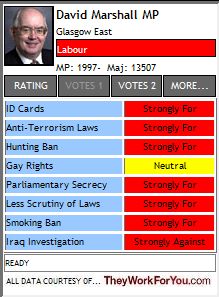
The medal has to be go somewhere though, so I will use my judges discretion and, after due consideration, I will award it to David Marshall, MP for Glasgow East and the runner-up in this particular contest, whose overall voting record, whilst still seeming to be possibly religiously influenced is less convincingly so than Mr Benton's and smacks much more of traditional authoritarian leftism, without some of Benton's redeeming features.