


Wednesday, August 22, 2007

Rugby Returns II - Seasonal Chaos

Ben Cohen
Cohen in full flight at the 2003 World Cup
Today's rugby news feeds brought brought the news that Ben Cohen, one of the England's 2003 World Cup winners looks to have parted company, though perhaps not in the strict legal sense, with the club with whom he has spent his entire professional career, last year's relegation victims, Northampton Saints.

It's another blow to the Saints following on from last year's relegation and other events such as the loss of former England hooker, Steve Thompson to a neck injury which made playing on to dangerous option to consider.

It appears to be over a bit of a tiff about the Saint's captaincy, which is a bit of a shame as Cohen looked set to be one of the many over the years who have had a career long relationship with the club. At his best, even beyond what he did in an England shirt, he was once of the players you really liked seeing play, even in an opposition shirt, much as another Northampton great, Tim Rodber, was for me in an earlier generation.

Cohen was also the subject of one of my favourite Rugby stories. It may be apocryphal but it was told to me by a lifelong Saints fan, so it may also have a little more truth to it.

Allegedly one season his agent suggested a promotional calendar be published for Cohen's fans. This was duly produced featuring Cohen in all manner of action shots, breaking tackles and taking glory dives over the try line. Sales were actually rather disappointing, so on the advice of his agent he tried a different tack and went for the female market, appearing largely shirtless and oiled, much like the promotional pictures of the French team at the last world cup. Sales shot up the following season much to everyone's delight. The only down side was that he had to take a lot of ribbing from team mates when it was revealed that the proportion purchasers who were male had actually increased, and a surprisingly large proportion seemed to have little known affiliation with the Northampton or the club.

It will be a shame not to have the Saints in the Premiership this season. Franklin's Gardens has always been one of my favourite away venues to visit, even before the investment that gave them a modern purpose built rugby stadium. It's likely only to be a very temporary stint in National 1 though, with the bookies offering odds 1-4 on a return to the Premiership next season, versus 13-2 for nearest rivals Exeter Chiefs.

If this comes to pass then it will be yet an extension of a pattern seen in every season bar one since 2000 where the relegated team bounces straight back. Since the introduction of the current 12 team format only one other team has joined Rotherham in being unable to secure a premiership return.

This perpetual swapping of the same teams between the bottom of the premiership and the top of National 1 is incredibly wasteful. There are parachute payments for the relegated club, which will go some way to compensate for the financial damage of what will be, in all probability, just a single season out of the premiership, but in the end it all seems pretty pointless.

I don't agree with ring-fencing the Premiership, and ending promotion and relegation but I'm sure there must be a more efficient way to manage things. Unaware of, and therefore ignoring some of the political issues my proposal would be as follows.

Firstly, expand the Premiership back to its original professional size of 14 teams. There are clearly a core set of 13 teams which are capable of playing some sort of a relatively permanent part of the Premiership setup as things currently stand.

So why 14? Well I could see two scenarios emerging. Ideally I would love to see a team from the far South West, one of rugby union's strongholds, but still without Premiership representation, join the the current 13 Premiership regulars. Exeter are getting pretty consistent, but they are not quite there yet, but if they or another team from the region did make it and took the place for a season or so I'm sure the lift in support would make them able keep them up to the standard of the Premiership, and rugby union's geographical coverage would be much improved. If this did not happen, the worst that would happen is that a series of teams would probably vie for the chance for a glory season in the Premiership; a far more positive way of seeing it than the reverse perspective of the temporarily relegated Premiership team.

I could also envisage the type of 'Bottom of Premiership v Top of National 1' two-legged play-off to see if promotion and relegation takes place, that existed during certain seasons, reintroduced, to stabilise the Premiership without the complete barrier of ring fencing.

This proposal would add four games per season to each teams schedule, which is not ideal, in view of the accepted wisdom that players are playing too many games, but I also suggest a compensating element to the plan.

Basically, I would scrap the Anglo-Welsh cup. I've never met anyone, English or Welsh, who really cares about it, it's got a bizarre format, and in all honestly I can't even remember who won it last year. Anglo-welsh competition would still exist in the two European cups, just as it does between English and Scottish clubs, and English and Irish clubs. I know the revenue is important, especially to the Welsh Rugby Union, and I think, considering the financial power of the English game and the long term interests of the game, it is sensible for such financial support to continue. I would just prefer it was in the form of generous deals on European Cup or Six Nations TV money.

Scrapping the Anglo-Welsh cup would mean a loss of at least three fixtures for each English club almost making up for the additional Premiership fixtures, as well as offering the chance to simply the structure of the season into clear domestic, European and international phases.

Naturally though the chance of any such simple solution which would offer the clubs a chance to grow in security, with a simplified season of no significantly greater length, has a cat in hell's chance of getting anywhere in the politicised world of today's Rugby Union.

Not in My Name

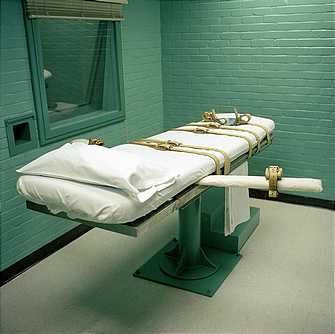
Lethal Injection
Texas approaching its 400th Execution
Fist of all let me say I am opposed to capital punishment. It's harder actually to say why I am; it's not especially an issue of morality - I do believe there may me crimes so terrible that it may be an appropriate price to play, nor is it concerns over miscarriages as I believe that there are cases where the evidence is sufficiently incontrovertible. It guess just comes down to some ephemeral statement about the kind of society I want to live in, one where we hold back from the ultimate sanction and show a degree clemency even in the face of the most vile of provocation. In a sense I wish the law had remained as it stood for a period in many countries prior to abolition, where, while the sentence remained on the statute books commutation to life imprisonment was automatic. It would be to some extent a legal fiction, but in another way it would be a powerful statement by society on its values, and on the true horror of certain crimes.

It's no longer a particularly political issue per se in the United Kingdom, with the matter always having been a matter for a free vote in Parliament, and a degree of polling evidence showing support, though not overwhelming support, for the position our Parliamentarians have taken over the last forty years.

I do not however, in any way, welcome the call by the EU for the Governor of Texas to get rid of the death penalty there yesterday, as it prepared for its 400th execution since the restoration of the penalty. According to the BBC, the Portuguese presidency:
"The European Union strongly urges Governor Rick Perry to exercise all powers vested in his office to halt all upcoming executions and to consider the introduction of a moratorium in the state of Texas."

Source: BBC News

It is true that not having capital punishment is a precondition of EU membership. To campaign for abolition in a state of another non-member sovereign nation however is an act of foreign policy, a foreign policy that the EU is not as yet authorised to pursue, and will only be permitted to do so under a constitutional settlement that at least in this country will be entirely morally illegitimate. The policy of the UK Government, while not explicitly stated is easily derived by its actions. While it makes strong representations on behalf of British citizens under the threat of capital punishment it appears reluctant to explicitly criticise the judgements of other nations, where the rule of law prevails, as they come to their own moral judgements on difficult issues such as this.

This was not an issue in which the Portuguese presidency of the EU should have attempted to overlay a pan-EU position on the respective foreign policies of the member states. It should not be recognised as being an EU position outside the corridors of power in Brussels because of the lack of authority from the people of the EU to represent them on such matters. It's also noticeable that once again the spotlight falls on the US with greater prominence than the 1000 plus executions carried out in China last year alone a similar number to the number of executions carried out in the whole US in the last twenty years since the reintroduction of capital punishment.

Despite my position on capital punishment, it was hard not to have more sympathy for the robust defence of Texas's position by governor's spokesman Robert Black:
"Two hundred and thirty years ago, our forefathers fought a war to throw off the yoke of a European monarch and gain the freedom of self-determination.

"Texans long ago decided the death penalty is a just and appropriate punishment for the most horrible crimes committed against our citizens.

"While we respect our friends in Europe ... Texans are doing just fine governing Texas."

Source: BBC News

Frankly, in this regard, Britons, even in the form of Gordon Brown, are also doing just fine governing Britain without the EU's assistance.

Rugby's Return I - Guscott

Rugby Premiership
Facebook Premiership - A Shameless Plug
With the Rugby World Cup not too far away, and the Guinness Premiership and Celtic Leagues also about to start their new seasons I thought it was time to make a first foray into my thoughts about the only sport that I will move me further than the local pub to watch. This of course is not in any way, shape or form a plug for my new Facebook application.

Premiership Rugby Predictor focuses on the upcoming Guinness Premiership season. It's basically based on match predictions (result and margin) for each round of the season, with points for predictions on the shape of the end of season league table too. You can see how your forecasts stack up against your friends, people who support the same club as you, and the whole user base, both on a weekly and season to date basis. If you are interested in English rugby beyond the national team give it a go, whether you have any club affiliation or not! The world cup and Celtic league versions will follow at the weekend. But as I said, I'm not here to plug my application by putting links to it all over the place.

There's quite a lot to look at as ever when a new season starts, especially in a world cup year. It's a bit early to be naming any heroes but an early zero has emerged in the form of Jeremy Guscott. ITV's coverage of the last world cup had its defects, but for all that I'm glad that we will be largely spared the opinions of Guscott as ITV holds the rights once again.

Guscott was one of the great centres of his era. He had speed, he had vision and he could finish. In terms of his performance relative to game as it was when he played it, he certainly deserves to be ranked amongst England's greats. That said, he had his flaws; he was never the most solid of players in defence, and at time could be accused of being selfish in possession. More significantly though, the game has moved on even in the relatively short time since he retired. Most great players acknowledge this fully; I have heard true international greats such as Colin Meads and Gareth Edwards openly wonder, with no false modesty, how they would fare in the physical game of today.

This is a concept that seems to go entirely over Guscott's head when he appears all too frequently as a pundit on BBC rugby coverage, and in the dead tree press his former England midfield partner Carling seems to fare little better. In both cases it is typified by their vilification of Andy Farrell, with Guscott in particular crossing that line between fair criticism and knee jerk contempt all too often.

It is typified by Guscott's comments on Faz's inclusion in the England world cup squad, on the BBC during halftime in the recent Scotland v Ireland warm up game:
"Well everyone knows what I think about him" (sneering tone pretty obvious)

First of all, the tone of his comment showed immense disrespect to a fellow sportsman whose record, albeit in a different version of the sport, is of the very highest order. Almost a permanent fixture in the GB rugby league side since the 1993 he became its youngest ever captain at just 21, while winning a cabinet full of silverware with his club side Wigan. Only three years ago he achieved a rare feat of winning both the Golden Boot, awarded to world’s leading player, and the Man of Steel, which goes to the best player in the Super League.

Has his entry to Ruby Union fallen short of some expectations? Certainly it has, with injury playing a significant part. That said, I'm glad to see him in the squad to be honest. World cup rugby is attritional fare, keep the ball, stop them playing it when they have it, kick your penalties.

I suspect Faz will start in a lot of the big games with this in mind. Not to make the great line breaks RL style and I think he knows that it won't happen with 15 defenders on the park. He's there to tackle, bring a bit a maturity to the back line and give the odd offload to stir things up a little bit. First and foremost we can't have people charging through the fringes of the breakdown and Faz's workrate and organisation is good. I expect him to play no more than 50-60 mins in the big games while the big boys in the opposition get frustrated.

I can kind of see the strategy we're going with, with limited resources and it might not be exciting, but it is the right one. Stuff this crap about blooding youngsters, being on the receiving end of a thrashing teaches you very little and can be damaging to them. Remember 2003? bring on centres with stand-off skills and it changes the shape of the game, and takes the pressure of Wilkinson. It all reminds me of the 'why are they taking Catt?' questions in 2003 before the France game cropped up. The same goes for Robinson 2003, the same talking faces like Carling and Guscott had similar contempt for a relatively inexperienced rugby league convert before the tournament began.

Its interesting to compare Guscott and bum-face's knee-jerk anti-Farell lines with the more constructive comments of the likes of Will Greenwood, who played centre closer to the modern era, and it perhaps a bit less blinded by the money issues.

If I was to be critical of Faz, he does need to hit lower in the tackle. Just because you've smothered the other in the tackle and stopped his progress is not job done in RU, you need the man on the floor otherwise you'll just end up trapped in a maul - though his attept to push that French backrower's head a foot below the turf on Saturday shows that I think he knows this.

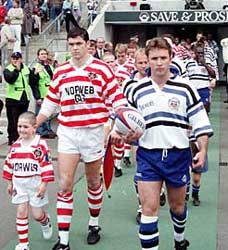
Bath v Wigan, 1996
Farrell leads out Wigan v Bath, 1996
I think it should be noted in view of the regular criticisms by Guscott of rugby league converts, that he mysteriously absented himself from the Bath squad when they played in Wigan in the first ever cross-code fixtures. This included a final at Twickenham, against a Wigan side led by one, erm, Andy Farrell. Nor should it be forgotten that in 1991, an England side featuring Guscott and Carling had an incredibly good chance to pick up their first World Cup victory. A dull but effective game plan saw them safely through to a Twickenham final against the Wallabies, whereupon an inexplicable switch to the time of more expansive rugby that Guscott always seems to be advocating under all conditions led to a 12-6 defeat, with most pundits to this day still being of the opinion that if they had stuck to their original style that England would probably have won.

Scanning the BBC message boards it appears that there is really only criticism of two or three of the thirty choices in the England squad, which is pretty good going in my opinion. It's going to be a tough tournament.

It's time for us all to get behind which ever team we support and to stop some of the whining tone. It's time for Guscott to shut up.

Restoring the Balance

The Jackal
Day of the Jackal
Having been a bit critical of the BBC recently, it's only fair to mention I did get a bit of pleasure out of the corporation last night even if it has caused me not to be feeling especially sharp this morning. I was already pretty tired when I got home last night, but flicking on the box I saw the opening of the original Day of the Jackal film adaptation on the BBC. I'm afraid it's one of those films I just can't switch off.

I'm not a particular fan of classic films, but this is one of those where the only ways in which it has dated actually add a little extra to the film. The locations, general style of the the time, and even the cars inspire a kind of nostalgia for a time that was largely before my birth and certainly beyond my memories. The political situation that underpinned the plot has also drifted out of public consciousness, but in this it acts at least as a reminder, if not necessarily a history lesson. The shadowy OAS (Organisation de l'Armée Secrète) did indeed exist and plotted over 30 serious attempts to assassinate General De Gaulle, before French intelligence proved its case against a number of its leaders, who were executed.

There was a great multinational cast and production team, which certainly adds to the films atmosphere, especially in the style of the cinematography, which was very much in the French style. The plot shows British and French police and secret services operating in very different ways, but in both cases very effectively and co-operating fully to a common purpose.

It's odd that the original author is now so commonly vilified as a swivel eyed little-Englander xenophobe by supporters of the EU, for his simple crime of not believing that the EU provides the only model for cooperation in Europe. But of course Fredrick Forsyth is not a little Englander or xenophobe, no more than the late Sir James Goldsmith was; the terms are just a mindless smears from those on the other side of a debate whose reluctance to engage properly in that debate is the real scandal. It's a tactic we have see again in the last few days in the increasingly desperate attempts of the left to attach the label of racist to Boris Johnson, seeing it as Ken's best chance of a third term. Fortunately their attempts seem to be backfiring somewhat, as the puerile Compass group report seems to be being treated with the contempt it deserves.

Another interesting link to more current affairs appeared when I was looking a web page on the film, who linked to an old article on the BBC website, where Mr Forsyth suggested a simple, low-cost approach to making the type of identity theft featured in his novel very much more difficult. Very presciently though Mr Forsyth observes in the article:
"Of course, bureaucrats would think of some expensive way of solving the problem."

Source: BBC News

He was of course, we now know, entirely correct, though I'm not sure even he could have anticipated the full extent of the expense, or the liberty crushing nature of the ID Card and National Identity Register scheme.

As a final observation, writing this post has made me recall a time when daytime TV, which my work schedule sometime makes me end up watching, I seem to remember often featured some classic films in the morning slots, like the old Basil Rathbone Sherlock Holmes adaptations.

As I said up front, I'm not really a fan of many of these classic films, but that said they are head and shoulders above the diet of 'crap in the attic', 'crap at car boot sales', and 'watch me buy or redecorate my house' shows we face these days. I suspect there's some mindless 'original content' target in play somewhere down the line; if so it is not money well spent. Licence fee payers money shouldn't go on this kind of rubbish that is available in any quantity on commercial channels.

If that means filling up the gaps in the schedule with material from the archives - so be it; it is, in effect, tax payers money, and as such should only be spent as and when it is really necessary to fund the type of programming that the market would not otherwise offer.

Hmm, I wonder if there's a prize for tying the most disparate topics to a single apparently unrelated headline post.

Silly Season Reaches Peak

Henry
Health and Safety
on the case?
There has been much talk on some other blogs about the arrival of 'Silly Season' where the summers absence of the usual more serious fare for the media to get their teeth into, especially in the field of politics, promotes second rate stories to unwarranted prominence, or forces them to make a feast from the few scraps their more regular sources still offer up. This year silly season seems to have been somewhat abridged by the floods and the reemergence of Foot and Mouth disease, but with these having left the front page silly season seems to have got underway with a vengeance. I therefore offer up my favourite couple of stories from the mainstream media yesterday, both of which would have appeared anyway, but seemed to have a bit more prominence on the respective websites than would have otherwise been the case.

First up, Sky News. Sky is not above a succumbing to the odd bit of tabloid appeal in its coverage at the best of times, but once it has made it to the Internet it tends to be tidily filed away in a section called 'Strange News' as any newsfeed addict will know. This however made the main headline news section yesterday:
"A dwarf performing at the Edinburgh Festival Fringe was rushed to hospital after he glued his privates to a vacuum cleaner.

Daniel Blackner performs in the Circus of Horrors as Captain Dan the Demon Dwarf"

Source: Sky News

It transpires that an 'special' attachment on Mr Blackner's vacuum cleaner had come loose and a hasty attempt to repair it with superglue went wrong. Readers will be relieved to know that after a valiant effort by nurses at Edinburgh Royal Infirmary, Mr Blackner and his appliance (the hoover) were finally parted.

Everyone who has been to the Edinburgh Fringe knows that genitalia based physical theatre has become a bit of a recurring theme in recent years. While I always passed on these shows when I was there, I do still value free expression and I've got a sneaking fear that some half witted Health and Safety officer's eyes will have lit up on seeing the story.

The last word must go to Mr Blackner:
"It was the most embarrassing moment of my life when I got wheeled into a packed A&E with a vacuum attached to me.

"I wished the ground could swallow me up."

Source: Sky News

I think Mr Blackner is fortunate, he knows now that he almost certainly has faced the most embarrassing moment of his life, given how hard to top it will be; for the rest of us it could still be just around the corner.

The Guardian, much as I might dislike its editorial line, is a usually a more serious voice than Sky, and its contribution to silly season is indeed on a much more serious subject, that of an 'armed' robbery:
A robber who held up a bookmakers with his girlfriend's vibrator was jailed today.

Nicki Jex concealed the Rampant Rabbit sex toy in a carrier bag and pretended it was a gun during the raid on the Ladbrokes shop in Leicester on December 27 last year.

Source: The Guardian

This is not to take anything away from the serious nature of any armed robbery, even with simulated arms. It is still a traumatic experience for the victims, and it appears that a customer, Mr Wayne Vakani behaved very courageously, following Jex to a local pub which led to the police collecting enough evidence to link Jex to the crime.

I can't help feeling though that the the nature of the simulated weapon did manage to creep in to the story more often that it normally would, and it certainly pushed the story way up the running order yesterday. I'm at all not convinced that the sentencing phase of a trial over charges on a robbery in December last year would have headlined quite so highly if say, Mr Jex had used a realistic replica weapon, doubtlessly a more frightening experience for the victims.

It just amusing to see that some of the more serious voices in the mainstream media can succumb to the same basic instincts as the the rest of us!

Tuesday, August 21, 2007

Off the Reservation?

Cameron and Redwood
Same crime, same MO, same culprit?
I've been having a bit of a groundhog day sensation over the last couple of days, so I feel compelled to post about something I wasn't going to bother commenting on as others had done so much more effectively. It's just that an interesting pattern does seem to be emerging.

Last week we finally saw the publication of John Redwood's competitiveness commission report, in all its 160 plus glorious pages. It was probably been a frustrating day for many Labour MPs who would normally be queuing up to condemn it, but were beaten to the gun by several of their own ministers and colleagues who chose to condemn its contents a couple of days beforehand, even before they were even known.

The most tawdry performance though was, as is so often the case these days, not by the Labour party itself, but by the BBC. Just a matter of days after the organisation disgraced itself over the early reports of the expected contents of the report, as highlighted by Iain Dale, with sufficient impact that Helen Boaden, the BBC's Director of News was forced to address the subject on the BBC's Editors' Blog, they repeated the offence on the day of the actual publication of the report.

Iain Dale's commments concerned mainly 5 live, but the same thing seemed prevelant on Radio 5. Listening to Radio 4, a venerable channel that, rightly or wrongly, most see as being the station of record when it comes to current affairs, on the day of the reports publication I was astounded to hear the same blatant disregard for impartiality once again as the 9AM news slot covered the item (OK yes, it had been a belter of a night so I slept through all the relevant parts of the increasingly anodyne Today programme). The figures hear are an approximation from a bleary eye staring at the clock radio, but won't be that far off:

  • 0-20 seconds: Presenter states that the report has been published, with a brief synopsis of its comments, concentrating on the more controversial proposals (which is fine by me!)

  • 20-40 seconds: Presenter states that reaction from the government has been very negative (surprise, surprise, but fair enough)
  • 40-god knows how many seconds: Long diatribe by government minister against the proposals, well over a minute (nothing from Mr Redwood, not even the most basic attempt at balance)

I was on the phone during the 10AM slot but I could just about hear it, and it seemed pretty much the same fare.

And then I had to go to work…and when I returned all had changed. The couple of hourly news slots I caught had nothing but the fact that the report was out, the synopsis of its contents, and at least one extended comment from Mr Redwood himself.

I wasn't going to comment on it on this blog, as so many others have done so already and more effectively, but then this week has seen pretty much a repeat of the same behaviour in the coverage of David Cameron's offensive on hospital closures. Once again the Today programme would be hard to lodge an effective complaint against as only the tone of the reporting betrayed the well known political sympathy of the programme's presenters, while a paper transcript would at least show a fair attempt at balance. The news bulletins which followed though were once again manifestly biased towards the government's refutation of the claims made by the Conservative team, mentioning them only as preamble and context to the minister's bile. Yet again, by lunchtime the item had been replaced by a more balanced offering, though only once it had ceased to be the lead item.

For what it's worth I do genuinely believe the BBC News editorial team are sincere in their desire to be impartial. I do doubt though that they fully appreciate the scale of the internal cultural problems they will have to surmount to achieve impartiality. Nor do I believe that the fulcrum around which they seek to achieve balance lies at a point that would be consistent with the weighted average of views of people in this country.

The lack of the impartiality of some of the coverage of some of the morning radio news coverage has surprised me, even from my slightly cynical standpoint, especially considering the renewed spotlight on these matters at the BBC, and the early signs that the organisation is at least recognising that it has a problem.

So stark has been the contrast with some of the later bulletins, which in some cases could have been accused of lack of balance in the opposite direction, that it leads me, from my position of complete ignorance on the matter, to speculate on the management structures that may be in play. I assume that while the heads of the editorial function are on call 24/7 that they must delegate a great deal of authority at certain times to duty editoral staff. I would probably expect that hinterland between drive-time and lunchtime not to be one of more heavily supervised time spots, compared to the key early morning, lunchtime and evening coverage, and would expect day to day operations to be delegated to someone lower down the food chain.

All of this leads me to wonder if there is just a bad apple there somewhere in the radio 4 set up, someone who has gone completely off the reservation. If so it's essential that they are dealt with firmly and decisively as they are clearly harmful to the corporation's image. I have had juniors working for me who've headed down the same route, and to be honest it's the devil's own job to ever trust them fully again, even in the unlikely event that you can shake them from their belief in their own righteousness.

I wish no real malice on anyone, but I would have to say that with the issue of BBC impartiality in the spotlight, and numerous seminars and training courses supposedly having been undertaken to address perceived shortcomings in this area I think there's little much more that could be done with such a rogue element. I would have to say that in my opinion that the very need for the training and seminars should in of itself have constituted fair warning, leaving summary dismissal as the only viable option.

It's a shame really. I have little opinion on healthcare never having needed more than a quick visit to A&E post-rugby in the last twenty years, but I found the Redwood commissions proposals interesting. Largely to my taste, and certainly controversial, but the debate has to happen sometime because right now we are heading down blind alleys on so many fronts as a nation. Unfortunately I've got a sneaking suspicion that the chances of individual components being implemented is pretty much inversely proportional to their probable benefit to the country, due to their political risks.

The attack on the health on safety culture is a case in point. In the world of business it is a pendulum that has swung to far, and it has wrought a terrible price in so many other walks of life, as the almost pathological aversion to risk by pointless non-job officials blights more and more of the harmless attempts by well meaning people attempting to add something to society.

The problem is that even to suggest it sounds like a call for the return of 19th century factory conditions, and offers an easy target for facile knee-jerk comments from even the most half-witted of NuLab MPs.

Wednesday, August 15, 2007

A Debate Without Substance

Saltire
Is Scotland being offered an honest choice?
So then, Alex Salmond has revealed his white paper addressing the future constitutional settlement for Scotland.

To be fair he does offer a 'national conversation' on series of options, before any referendum should be called:

  • The Status Quo

  • Further devolution of powers to Holyrood

  • Full independence
I'm not sure how the first of these options squares with the position attributed to him by the BBC that "no change is no longer an option", but compared with the flagrant dishonesty of the Westminster government over the upcoming. European Treaty it's pretty small beer. What I can't quite see yet is what the nature of his 'National Consultation' with the Scottish people is likely to be. I must say, first and foremost, that I cannot, and do not accuse Mr Salmond of any intent to deceive or mislead in his approach. His is a principled position about which he and his party are perfectly open, and I'm glad to see that many of his political opponents and most of the media have also acknowledged this fact and have delivered their response to the white paper in a considered and reasonable manner. It's interesting to compare this to the hysteria that is whipped up by certain national broadcasters when ever someone has the temerity to suggest a devolution of powers from Brussels back to nation states, but that's a posting for another time.

I still can't help thinking though that the kind of 'National Conversation' that Mr Salmond seems to anticipate falls some way short of addressing the issues that worried me in my previous posting. Certainly the grand debate should take place, but as things stand it would take place in an arena of ignorance and empty rhetoric.

The type of exercise I was speculating on yesterday was not the same as what Mr Salmond proposes, it is a precursor, and in my opinion a necessary precursor to it. The analysis of the economic consequences of independence and to a large extent those of the political consequences on the world stage should not, insofar as is possible should not be become a political football in the course of the debate, they could be, and should be, largely a matter of accepted fact.

The type of exercise I envisaged was something more along the side of a Royal Commission, vested with every power possible to make as many politically incontrovertible analyses of the facts of the case for and against independence. I would expect it to be manned by economists, lawyers and experts in the field of international relations, not politicians. Government departments, both British and Scottish, should be called upon to contribute, but at the level of the real experts, not their political masters. The only way the big political beasts should involve themselves is in making it possible for the commission to do its job, for example making it clear that EU officials should make themselves available to discus the potential shape of a post-independence relationship between Scotland and the EU, including the financial consequences.

My own feeling, for what it is worth, is that Scotland can clearly stand alone as an independent state; my instincts are that economically it would be somewhat poorer, but possibly only to an extent that many Scots would see as an acceptable price of independence, while the consequences for Scotland's influence in the world, especially within the EU would be more serious, but possibly acceptable again to some as a price worth paying. That's just my gut feeling on the matter, and when I hear politicians speak on the matter I always get the feeling that they are working off a base of knowledge that is hardly any sounder. That is why I am so convinced the expert analysis is needed first so that any public and political debate can be around a body of solid fact.

As an aside, I think some of the lines being pushed in some parts of the mainstream media, and the world of blogging, that the rest of the UK should be consulted in a referendum, is misguided. While it is possible to wrap up such an idea in a mantle of high sounding principle, it is feel it is simply wrong. I might be half Scottish, work there from time to time, and love the place, I really don't feel I have any great right to demand a say in how the government of that part of the country should develop. Certainly there would be an impact on the rest of the United Kingdom, but due to the weight of relative sizes it is almost certain that it would be insignificant in comparison to the effect on Scotland itself, and so to demand a vote of equal weight is not really justified.

Exactly the same arguments could be made for offering the rest of Europe a vote on whether the UK should adopt any EU treaty. I seem to remember that when that referendum was still on the table, even the suggestion that UK resident Non UK EU citizens be allowed to take part in the vote had many of the same mouthpieces spitting blood in indignation. The possible accusations of hypocrisy raised in the article by Guido quoted in the previous vote must be avoided at all cost.

Monday, August 13, 2007

Bad Habits

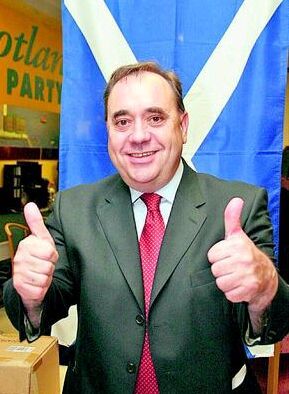
Alex Salmond
Salmond: Early promise evaporating?
It's becoming a recurring theme since I've been writing this blog, that every time that I try to be open-minded about those with different political persuasions to my own and I give deserved credit where it is merited, that the unwitting recipient recipient of the praise immediately blots his or her copybook.

It's going to be hard to beat
Liam Byrne, who sadly followed up on his admirably swift action over the case of Tul Bahadur Pun VC with his ridiculous pronouncement about ID Cards becoming "A Great British Institution, but Scotland's First Minister Alex Salmond seems to be having a damn good go.

I'm reasonably, but not obsessively pro-union, but some time ago I felt moved to pass favourable comment on the style with which the SNP and its supporters campaigned in the recent elections to the Scottish Parliament, much as I might be uncomfortable with some of its policies. After a week or two of Mr Salmond forming his government I was once again pleased to see the it was exercising its first real power in what seemed to be a reasonable, pragmatic manner.

Unfortunately in the last couple of weeks the train really does seem to have come off the rails, or perhaps it might be more accurate to say the train has gone very much back on to the rails that some like I may have always expected it to run down. There have been a sequence of stories suggesting that the nationalist hard core of the SNP's programme is starting to take centre stage.

They began with a number of fairly low key announcements about separations in the functions of elements of the British and Scottish Civil Services. Later on came a more headline grabbing, but perhaps less serious in many ways, demand for a much greater degree of autonomy in broadcasting, specifically the replacement of British (i.e. English as seen through SNP eyes) news coverage with specifically Scottish versions. Now, of course, we await the SNP proposal for a ballot on Independence, due out tomorrow.

The first element of this assault appears designed simply to be a move designed to promote a senses of 'separateness', unaccompanied as it was by any suggestions as how such separations of civil service functions would in any way offer better services or greater efficiency in their delivery to the Scottish people.

The proposal for a separate news service also seems somewhat suspect. I live in a region of the country that has a significantly larger population than the whole of Scotland, and originate from a different one, which though slightly smaller had just as strong a regional identity as Scotland. In neither case has the already significant amount of regional news programming ever really captured my imagination, compared to national coverage. In both cases the few really newsworthy stories always have to be supplemented with swathes of dull parochial dross even to fill half and hour. Scotland may have a little more to offer its viewers, especially with a whole distinct political system to cover, but I've got a feeling it wouldn't entirely escape the limitations of existing regional coverage.

The call for a referendum, is a trickier issue in my mind. Guido, who has also proved my rule in the reverse direction, by making a succession of interesting posts ever since I submitted my Top 20 blogs without him, has turned his mind to the same issue I have on the Scottish referendum question:
Is Guido the only one who thinks it hypocritical of the Tories to be against a referendum on Scottish constitutional affairs and for a referendum on UK independence from the European constitution?

Why is self determination good for the UK but not Scotland?

Source: Guido Fawkes

Well yes, it's a fair point, and one that has been an issue for me when I think about such a referendum. In the end though I really do believe that there is something in my discomfort with a Scottish independence referendum at this time that goes beyond the simple fact that in the case of Scotland I am content with the status quo, and in the other I am unhappy with what the status quo looks set to become.

It is, I think, simply this. In the case of the European ConstitutionTreaty, we have a fair idea of what the consequences of its adoption are likely to be, and were a referendum to take place we would have a precise document to vote for. I do not think that at this time the same applies in the case of Scottish Independence. It is clear that no politician on either side of the debate is fully certain of the consequences, especially the economic ones, to Scotland.

There are often a vague claims from SNP supporters that Scotland would either become like Ireland with its boom of the last decade and more, or like the Scandinavian countries. You can ignore the duplicity in claiming both to be germane to the case at hand and seriously worry if either of these models stand up to close scrutiny. In the former example will the EU be in a position to offer the type of funding to Scotland that it could, and still does to Ireland? I'm sure Brussels would be delighted to see a country opt for 'Independence in Europe' - but in the newly enlarged Europe with so many poorer countries in Eastern Europe, will such largess ever be possible again? In the latter case, are similar latitudes, populations and natural resources a guarantee of having similarly successful societies?

There are many issues beyond the simply economic, such as the voice Scotland might have in the EU as an independent nation, versus that as part of the United Kingdom whose voice would be little weaker without Scotland and may adopt very different positions without the necessity to consider consequences to Scotland. The economic issues alone though are enough, in my mind, to warrant further consideration before pressing for a referendum.

If the SNP were to propose a commission to consider these issues and report to the Scottish people after a year or so, possibly with a view to a subsequent referendum then I suspect, on the grounds of self-determination that Guido alludes to, it would have my support. The step into the unknown that the SNP are likely to propose to the Scottish people is something that I feel all opposition parties have the right to activly opposed, especially considering the limited mandate of the SNP administration.

Saturday, August 11, 2007

The Last Acceptable Prejudice?

England Rugby
I'm well into my big match build up now. I refer of course, not to anything thing to do with the new kevball premiership season which has just kicked off (did it ever go away?), but England v France at Twickenham today.

Warming up by watching Scotland v Ireland as been a bit like watching a replay of England thrashing Wales last week, as the home side's big pack looks, as of half-time, to be strangling the life out of the Irish. Being of partly Scottish descent, I'm delighted to see Scotland performing, especially after some of the well publicised woes of the game north of the border.

More foolishly though, I decided to pass my eyes over the BBC's rugby forum, and was disappointed to say that as well as being frustrated by the piss poor design of the web site, sadly the same mindless anti-English bigotry seems as strong as ever. There are culprits of many nations but it has to be said that a certain, and I would have to say from personal experience wholly unrepresentative, segment of Welsh support predominates.

Several thoughtful posts analysing the England victory last week attracted the usual accusations of 'arrogance', with whining complaints that England were only playing a second string Welsh team (a fact fully acknowledged in most of the original posts). 'Triumphalist', 'boring', 'would never have beaten X, Y or Z'; all the usual bile trotted out, usually by someone who hadn't even taken the trouble to read the more considered original posting. There were clear weaknesses in England's performances and most of the English posts reflected this, but a win is a win, and you can only beat the side in front of you, to trot out a couple of cliches.

I actually don't care about the actual content of the posts per se, supporters of England rugby have heard it for years; it's water of a duck's back. I certainly don't want to see any extension of the powers of the thought police, like the ridiculous investigation into Anne Robinson's alleged anti-Welsh comments. There is a bit of sadness that these perpetual knockers spoil the generally very amicable nature of rugby supporting throughout the world. More than that though, I object to the underlying tone that for some reason, England alone, are not allowed to celebrate their team's victories in the same uninhibited, and yes, sometimes over the top, way as any other nation.

The only time I encountered anti-English sentiment face-to-face, that stepped just over that line beyond good natured banter was also rugby related, when I happened to be in Dublin when Scotland were playing Ireland there in the 6 Nations. After the game the Irish and travelling Scots united in their abuse of the common enemy. I couldn't help find it a little bit ironic considering the the involvement so many Scots in the development of the Ulster situation, a little bit of history that was conveniently forgotten for the evening. Ah well, it was a good night anyway, and as my mother would say, never spoil a good story for the sake of the truth.

Anyway, time to head to the Base Camp, in order to avoid the usual fonts of ignorance at the Mother Ship.

Good luck in the World Cup, to England and Scotland, and yes, to Wales and Ireland too.

Wednesday, August 08, 2007

Everyone else is doing it...

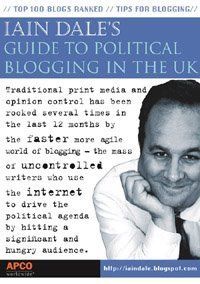
Iain Dale's Book
Voting open until 15th August
...so shall I.

As posted in the earlier hours of this morning, I've been finalising my list of 20 blogs for contribution to Iain Dale's search for the Top 100 UK Political Blogs, which will form part of the upcoming book, 2007 Guide to Political Blogging in the UK.

It's been a little more tricky than I expected, as I wanted to apply some kind of objectivity to the subject; like most people I probably read some blogs not in this list, to which I have a greater political affinity, more often than some which I have included as being, in my opinion, the best examples of blogging from a perspective different to my own. Even with that proviso, I will admit it's pretty one sided, perhaps even more so than my own political position actually warrants; I consider myself a pretty moderate EUrosceptic, but I just couldn't ignore too many of the many intelligent blogs which lay into this organisation with such a powerful mix of wit, venom and exasperation.

A also dropped a few on the grounds of a handful of rules I set myself, some in the interests of objectivity, others to do with my idea of what a blog should be. Boris Johnson MP has a brilliant blog, but the postings are a bit too thin on the ground to get much of a dynamic behind it, despite an admirably liberal policy on commenting. CiF Watcher, LibertarianUK.net and
Educational Conscription have all got off to a fantastic start, content-wise, but I felt were a little new to include. Others, like Archbishop Cranmer I enjoy immensely, but I feel really have politics as a secondary theme, woven in as and when necessary.

I've also got a bit of a short term memory when it comes to these things. I regretted leaving out Tom Watson whose usually good blog I disagree with often; only a few recent activities that I felt were beyond the pale spared him from the embarrassment of appearing on such a true blue list. Also, like anyone interested in blogging from a Conservative point of view it felt strange to omit Guido, but as he himself has announced, there are many more important things in his life than blogging right now, and I don't think many would dispute his priorities right at the moment, and he's still a very good read.

I've ended up with a bit of a weird mix of 'best in class' and overall champions, but anyway, after all that rambling, here is the Liberty's Requiem Top 20, in alphabetical order:If and when my hosting provider unblocks my Blogroll for Facebook Application, and it gets a few more users, I might have to consider a 'blog read compatibility rating' feature...It's been quite interesting, seeing so many other peoples top 20s on various blogs, to work out just how many great, and thankfully rare not-so great minds I think alike to!